
As the Indian squad for the ODI series against New Zealand awaits official announcement, one thing is already clear: this selection is about far more than just a bilateral series. With the next ODI World Cup on the horizon, the Board of Control for Cricket in India (BCCI) is laying the foundation for the future—and sometimes, that future looks a lot like experience.
Over the years, Indian selectors have tried repeatedly to move past established superstars. Names like Rohit Sharma and Virat Kohli were often whispered alongside the word “transition.” Yet, their bat continues to answer louder than any selection debate.
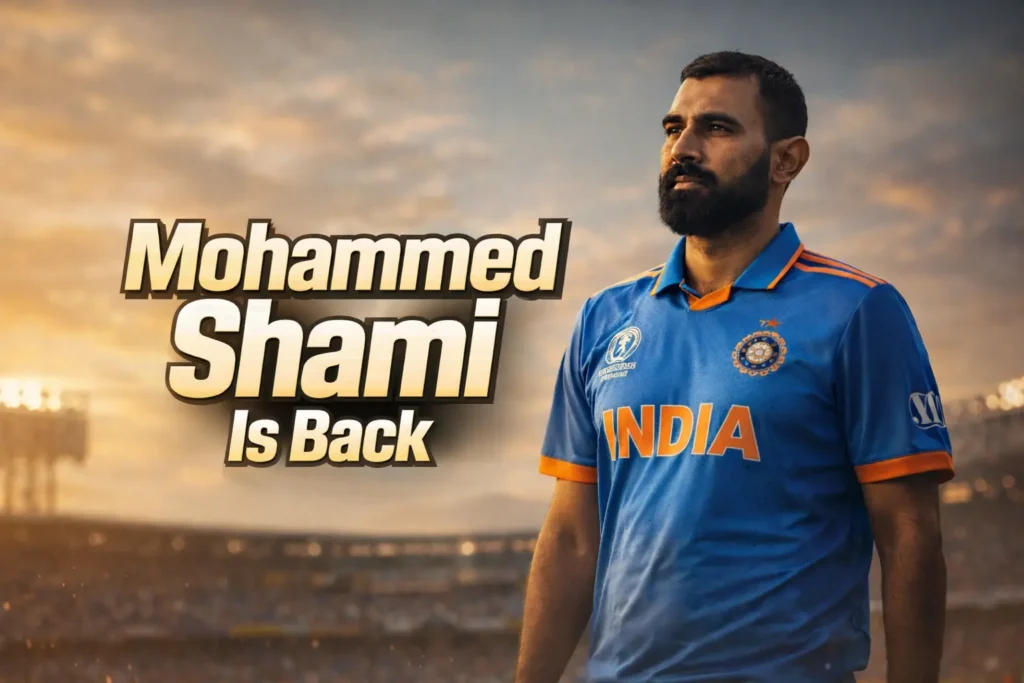
But the most compelling comeback story belongs to Mohammed Shami.
The Backbone of a World Cup Campaign
In the last ODI World Cup, Shami was nothing short of extraordinary. Despite playing only seven matches, he finished as the tournament’s highest wicket-taker with 24 scalps—an unreal return that underlined his match-winning ability. He arrived late into the playing XI, but once he did, India never looked back.
Shami bowled through pain, through injury, and through pressure—only to be sidelined afterward for nearly a year. Many thought that was the end.
It wasn’t.
Domestic Cricket’s Loudest Statement
When the national doors appeared closed, Shami did what champions do—he went back to basics. Representing Bengal, he dominated across all formats: Ranji Trophy, Mushtaq Ali Trophy, and Vijay Hazare Trophy. Wickets flowed, overs piled up, and fitness doubts quietly dissolved.
Over 200 overs in one domestic season is not the workload of an unfit bowler—it is the signature of a workhorse.
Age Is Just a Convenient Excuse
Critics pointed to Shami’s age. But cricket has moved beyond that illusion. When Rohit Sharma tops ODI rankings at 38 and Virat Kohli follows closely at 37, when fast bowlers like Mitchell Starc and Scott Boland thrive in their mid-30s, the argument collapses.
Performance is the only currency that matters—and Shami is rich in it.
You Can Delay Greatness, Not Deny It
There were moments of friction. Words were exchanged. Frustration surfaced. But even then, Shami let the ball do the talking. Former greats like Sourav Ganguly and Harbhajan Singh backed him openly, questioning how a bowler of such caliber could be ignored.
Now, reality has caught up with reputation.
Mohammed Shami is not a nostalgic selection. He is a necessary one.
With eyes on 2027 and a present that still demands excellence, the question is no longer why Shami—
it is how long can you afford to leave him out?
Because heroes don’t disappear.
They wait for the right moment to return.