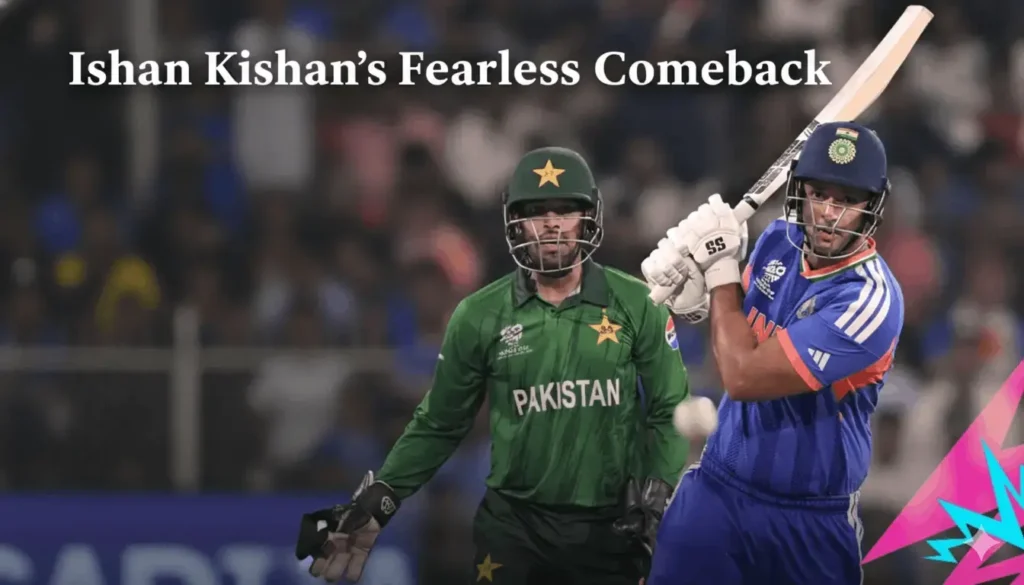

At this moment, it would be unfair not to acknowledge the role played by former India selectors R.P. Singh and Pragyan Ojha. Their firm voices in selection meetings ensured that Ishan Kishan was brought back into the Indian national side, even when discussions were heavily revolving around other names like Shubman Gill and Sanju Samson.
Having personally witnessed Kishan’s explosive performances in the Syed Mushtaq Ali Trophy, they conveyed a strong message to chief selector Ajit Agarkar: Ishan deserved another chance.
It was a high-risk move. Replacing an established top-order name in a major tournament squad always invites scrutiny. One minor failure could have triggered heavy criticism. But Kishan has justified that trust 100 percent. With every match, he continues to prove that the sweat-soaked Indian jersey truly belongs to him.
The Colombo Masterclass

If there was ever an innings that defined India’s batting narrative in a “before and after” manner, it was Kishan’s assault at the R. Premadasa Stadium in Colombo.
Pakistan entered the contest with a detailed blueprint to tackle India’s left-handers at the top. Familiarity with the pitch, toss advantage, and a spin-heavy strategy were all in their favor. Captain Salman Ali Agha tried to spring early traps.
But Ishan Kishan was not part of Pakistan’s syllabus.
Facing Shaheen Shah Afridi, Kishan smashed the very first ball of the second over over deep square leg for six — a bold statement of intent. Pakistan’s plan to pressure India early collapsed almost instantly.
When pace didn’t work, Pakistan shifted to spin in the powerplay. Specialist spinner Abrar Ahmed and Saim Ayub were rotated in an attempt to slow him down. But Kishan had reinvented himself.
He attacked both pace and spin with equal authority. It felt as though he was batting on a different pitch altogether.
Reinvented Off-Side Play
Previously considered stronger on the leg side, Kishan showcased remarkable improvement on the off side.
- 77 runs off 40 balls
- 25 runs through the off side alone
When Pakistan’s spinners tried dragging him into leg-side traps, Kishan responded with late cuts, cover drives, and reverse sweeps. The turning point of the game began right there.
Later, Kishan revealed he had worked tirelessly in the nets to eliminate his off-side weakness. The results were visible for the world to see.
By the time he was dismissed in the ninth over, India’s score read 88 — and Kishan had contributed 87% of those runs. The run rate was above 10.
After his dismissal?
The run rate dropped from 10.1 to 7.6.
That one innings changed everything.
Record-Breaking Fifty
Kishan reached his half-century in just 27 balls, registering one of the fastest fifties in India-Pakistan T20 World Cup history. He narrowly missed surpassing Virat Kohli’s iconic 82 against Pakistan at the Melbourne Cricket Ground.

4
Before the match, social media debates centered around “Indian batters vs Pakistan spin.” Pakistan even fielded six spin options.
But Kishan dismantled that strategy:
- 66 runs off 37 balls against spin
- 41 runs off just 17 balls combined against Abrar Ahmed and Shadab Khan
Abrar, known for his tight economy against other teams, once again struggled against India.
The Transformation
Since losing his place in late 2023, Kishan’s game against slow bowling has transformed dramatically:
- Strike rate vs spin earlier: 138
- Strike rate after comeback: 214
That jump isn’t accidental. It’s evolution.
His resurgence began in domestic cricket, especially in the Syed Mushtaq Ali Trophy, where he led Jharkhand’s charge:
- 517 runs in 10 matches
- Strike rate of 195
That performance forced selectors to reconsider their T20 plans.
Numbers That Matter
In his T20 comeback so far:
- 376 runs in 7 matches
- Batting average: 53.28
- First Indian wicketkeeper-batter to win Player of the Match in a T20 World Cup fixture
Even when teammates like Abhishek Sharma struggled for consistency, Kishan’s fearless approach ensured India never lost momentum.
When asked what changed during his break from international cricket, Kishan’s answer was simple:
“I reinvented myself. I corrected my mistakes.”
From the mischievous youngster in the Indian camp to a reliable utility player — this is more than just a comeback. It’s a transformation.
What Next?
Ishan Kishan’s innings in Colombo wasn’t just about runs.
It was about intent.
It was about courage.
It was about reclaiming belief.
If this is the new version of Ishan Kishan, Indian cricket may be witnessing the rise of a defining T20 match-winner.
And perhaps, this was just the beginning of another masterclass.