
The latest team announcement from the BCCI has triggered major discussions across the cricketing world. When BCCI Secretary Devati Saikal unveiled the T20 World Cup squad, Selection Committee Chairman Ajit Agarkar stood beside him—an important gesture after months of criticism over his remarks and decisions. From comments on the future of Rohit Sharma and Virat Kohli, to shifting Sanju Samson from the opening slot, Agarkar’s statements often attracted controversy.
But Saturday’s major announcement appeared to correct past missteps and reflect that the committee had taken criticism seriously.
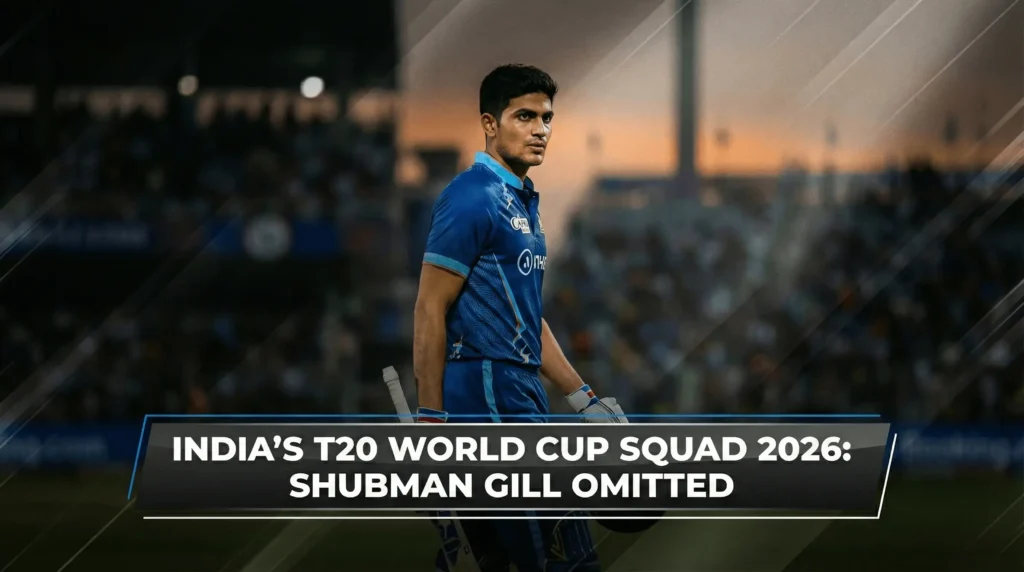
Gill’s Omission: The Biggest Shock of the Week
The presence of India’s ODI and Test captain Shubman Gill during the announcement process had earlier hinted that he would be part of the T20 World Cup squad. Reports suggest Gill had mentally prepared to play the tournament, and national media had all but confirmed his selection.
However, just hours before the official press meet, Gill reportedly received the news that he would not be included in the squad. Cricket experts interpret this as a strong signal against unilateral decision-making in team selections.

Even though Gill did not make a major impact during the South Africa tour, many believed he would still earn a spot due to his status as vice-captain. But Sanju Samson’s standout performances in the limited opportunities he received changed that equation. Bringing Gill back to the opening role would have been an extremely risky call—one that could have jeopardized the selectors themselves if it failed.
The decision also places a temporary pause on BCCI’s earlier plan to build Gill as a three-format cornerstone. His branding and marketing push now sits under question.
Agarkar’s Journey From Quiet Administrator to Controversial Figure
When Ajit Agarkar became chief selector in 2023, it barely made headlines. Known as a calm character on the field, many assumed he would be equally quiet in administration. But his bold and often polarizing team calls made him one of the most discussed figures in Indian cricket.
Throughout the year, BCCI and Agarkar strongly backed several players—only to withdraw that support later.
Examples include:
- Continued backing for Gill while several in-form players like Mohammad Shami waited for opportunities
- Giving Sai Sudarshan a Test debut, while consistently overlooking the red-hot Sarfaraz Khan in domestic cricket
- Keeping Mohammad Siraj restricted to one format, while Harshit Rana was considered across all three
- Ignoring Shreyas Iyer despite an outstanding IPL season
The Captaincy Puzzle: Unexpected Twists
After India’s T20 World Cup triumph, most expected Hardik Pandya—vice captain of the tournament and leader of many T20 series—to take over from Rohit Sharma. But the management surprisingly handed the role to Suryakumar Yadav, claiming Hardik’s recurring injuries were the reason. Many experts disagreed, questioning the authenticity of that justification.
Although India dominated every bilateral series under Surya and did not lose one, his batting showed signs of being affected by the responsibility.
Another major decision was removing Rohit Sharma from ODI captaincy after the Champions Trophy triumph. The signals were clear: the selection committee was preparing to move forward with Shubman Gill as the long-term white-ball captain. Statements from coach Gambhir and the selectors created uncertainty about the futures of both Rohit and Kohli.
Yet their masterclass performances in the Australia and South Africa series shattered that narrative.
With Virat Kohli back in prime form and Rohit delivering vintage knocks, the idea of going to a World Cup without the two giants became almost impossible.
The Tactical Shift in T20 Opening Strategy
Under coach Gautam Gambhir, India embraced a fearless T20 approach:
Abhishek Sharma and Sanju Samson as explosive openers, tasked with maximizing powerplay runs—even if it meant losing early wickets.
This template repeatedly pushed India to totals above 200.
But the strategy collapsed when Gill, as vice-captain, was inserted into the opening role. India suddenly struggled to score big in the powerplay, as Gill’s approach did not align with Gambhir’s aggressive blueprint.
The turnaround came in the final T20 against South Africa, where Abhishek and Sanju reunited as openers. The result:
- 63 runs in the powerplay
- India’s first 200+ total of the tournament
By reinstating the Abhishek–Sanju partnership for the World Cup, the selectors have made a clear course correction—one applauded by former players from Ravi Shastri to Sunil Gavaskar.
A Wake-Up Call for Both Agarkar and Gambhir
Until now, Agarkar had stood firm on controversial decisions, often unfazed by criticism. Gambhir too felt secure—believing that without stars like Rohit and Kohli, few would question him as coach.
But unexpected defeats, loss of form in players they supported, and outstanding performances from players they sidelined have forced both to rethink their approach.
The South Africa Test series loss has already shaken Gambhir’s position.
With the upcoming T20 World Cup, both he and Agarkar face a career-defining challenge.
Members of the selection committee—including Pragnan Ojha and RP Singh—are reportedly raising tough questions internally.